


Why Most Businesses Fail at AI Adoption and How to Fix It Before You Start
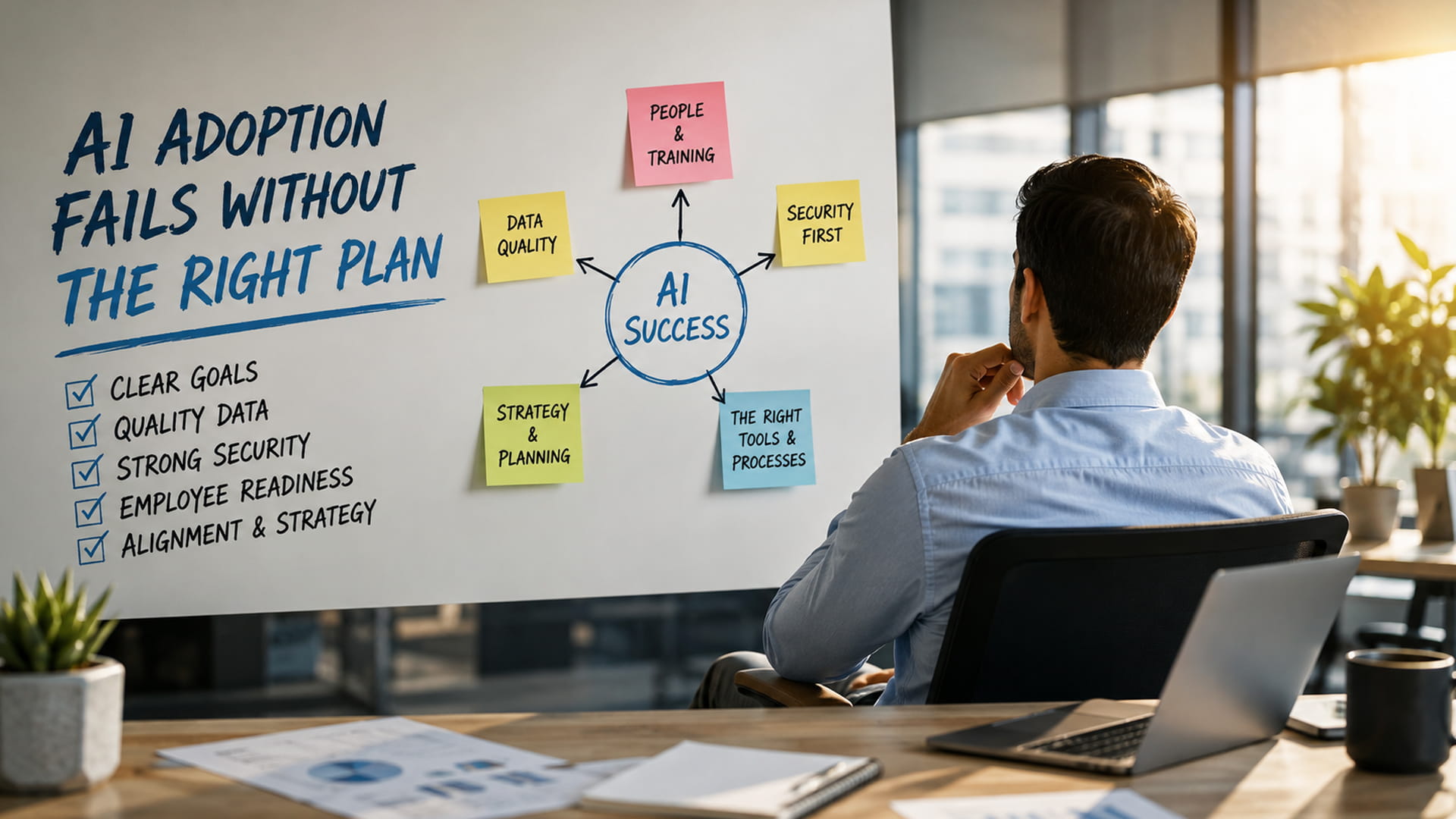
Artificial intelligence is becoming one of the most important technologies for improving business productivity and efficiency.
Organizations are adopting AI tools to automate workflows, analyze information, improve customer experiences, and support decision-making.
However, many businesses struggle to achieve the results they expect.
The problem is often not the AI technology itself. Businesses fail because they implement AI without preparing their data, security, infrastructure, and employees.
In 2026, successful AI adoption requires more than purchasing a tool. Businesses need a structured strategy that aligns AI technology with business goals while protecting critical information.
Managed IT providers help organizations prepare their technology environment and create a secure foundation for successful AI implementation.
Quick Answer: Why Do Businesses Fail at AI Adoption?
- Businesses often adopt AI without clear goals or measurable outcomes.
- Poor data quality limits AI accuracy and effectiveness.
- Weak cybersecurity practices create AI-related security risks.
- Employees may struggle without proper AI training and policies.
- A structured AI readiness strategy helps businesses achieve better results.
What Is AI Adoption?
AI adoption is the process of implementing artificial intelligence tools and integrating them into business operations.
Businesses use AI for tasks such as:
- Automating repetitive workflows
- Improving customer support
- Analyzing business data
- Creating content
- Enhancing decision-making
- Optimizing operations
Successful AI adoption requires more than technology deployment. Businesses must consider how AI fits into their existing systems, processes, and security environment.
Organizations that approach AI strategically can improve productivity and efficiency.
Organizations that rush implementation without preparation may experience:
- Low employee adoption
- Security concerns
- Poor AI results
- Unnecessary expenses
- Failed technology initiatives
Why AI Adoption Matters in 2026
AI is becoming a major part of modern business operations.
Companies across industries are exploring tools such as AI assistants, automation platforms, and intelligent analytics solutions.
However, the gap between experimenting with AI and successfully implementing AI continues to grow.
AI Is Becoming a Competitive Requirement
Businesses are using AI to improve:
- Customer experiences
- Internal productivity
- Operational efficiency
- Data-driven decisions
Organizations that create a responsible AI strategy can improve their ability to compete in a rapidly changing market.
AI Creates New Technology Challenges
AI requires businesses to evaluate:
- Data availability
- Infrastructure capabilities
- Security controls
- Employee readiness
Without proper preparation, AI projects may not deliver expected results.
Security Risks Are Increasing
AI tools can introduce new cybersecurity challenges.
Employees may unknowingly expose sensitive information by entering confidential data into unsecured AI applications.
Businesses need strong security policies before expanding AI usage.
Common Reasons Businesses Fail at AI Adoption
1. Lack of Clear AI Goals
One of the biggest mistakes businesses make is adopting AI without defining what they want to achieve.
Some organizations implement AI simply because competitors are using it.
Without clear objectives, businesses may struggle to measure success.
Effective AI goals should focus on:
- Specific business problems
- Expected improvements
- Measurable outcomes
- Employee needs
A successful AI strategy starts with understanding the business purpose behind the technology.
2. Poor Data Quality
AI depends on accurate and organized information.
Many businesses underestimate the importance of data preparation.
Common data problems include:
- Incomplete information
- Duplicate records
- Outdated files
- Poor organization
- Limited access controls
When AI systems rely on poor data, the results may be inaccurate or unreliable.
Businesses should review data quality before implementing AI solutions.
3. Weak Cybersecurity Planning
Security is one of the biggest concerns with AI adoption.
Without proper safeguards, businesses may expose sensitive information through AI tools.
Potential risks include:
- Data leakage
- Unauthorized access
- Unsafe AI usage
- Compliance violations
Organizations need AI security policies that define:
- Approved AI tools
- Data handling requirements
- User permissions
- Security expectations
4. Employees Are Not Prepared
Technology adoption depends on employee understanding and acceptance.
Many AI projects fail because employees:
- Do not understand how to use AI
- Lack proper training
- Fear technology changes
- Use tools incorrectly
Businesses should provide guidance and training to help employees use AI effectively.
5. Choosing the Wrong AI Tools
Not every AI solution fits every business.
Organizations may waste resources by selecting tools that do not match their needs.
Before choosing AI technology, businesses should evaluate:
- Business requirements
- Existing systems
- Security needs
- Integration capabilities
The right AI solution should support business goals, not create unnecessary complexity.
6. Ignoring IT Infrastructure Readiness
AI applications require reliable technology environments.
Businesses may face challenges if they have:
- Outdated systems
- Poor network performance
- Limited cloud capabilities
- Weak security controls
A strong IT foundation improves AI performance and reliability.
How Businesses Can Successfully Adopt AI
Build a Clear AI Strategy
Businesses should start by identifying where AI can provide measurable value.
A strong strategy includes:
- Business objectives
- Technology requirements
- Security considerations
- Implementation plans
Improve Data Management
Organizations should prepare their data by:
- Organizing information
- Removing outdated records
- Improving access controls
- Protecting sensitive data
Better data leads to better AI outcomes.
Establish AI Security Policies
Businesses should create clear rules for AI usage.
Policies should address:
- Data protection
- Approved applications
- Employee responsibilities
- Compliance requirements
Train Employees
Employees should understand:
- How AI tools work
- Appropriate usage
- Security expectations
- Best practices
Training improves adoption and reduces mistakes.
Risks of Poor AI Implementation
Security Vulnerabilities
Unmanaged AI usage can create opportunities for data exposure and cyber threats.
Reduced Productivity
Poorly selected AI tools may create additional work instead of improving efficiency.
Compliance Concerns
Businesses may face compliance challenges if AI tools handle sensitive information improperly.
Financial Waste
Investing in AI without proper planning can lead to unnecessary technology expenses.
How Managed IT Providers Support AI Adoption
AI implementation requires expertise across multiple areas, including technology, security, cloud infrastructure, and data management.
Managed IT providers help businesses prepare for AI through:
- Infrastructure assessments
- Cybersecurity improvements
- Cloud optimization
- Data protection strategies
- AI policy development
- Technology planning
An MSP helps businesses avoid common AI mistakes by creating a secure and scalable technology foundation.
Instead of adopting AI without direction, organizations can develop a practical roadmap that supports long-term success.
Learn more about managed IT services and how technology experts can help prepare your business for AI adoption.
Step-by-Step AI Adoption Framework
Step 1: Assess Business Needs
Businesses should identify:
- Current challenges
- AI opportunities
- Desired outcomes
- Technology requirements
Step 2: Identify Risks and Gaps
Organizations should review:
- Security weaknesses
- Data issues
- Infrastructure limitations
- Employee readiness
Step 3: Implement AI Solutions
Businesses should deploy AI tools with:
- Proper security settings
- Employee training
- Clear usage guidelines
- Testing processes
Step 4: Monitor Performance
Organizations should measure:
- Productivity improvements
- User adoption
- Security activity
- Business results
Step 5: Continuously Improve
AI strategies should evolve as technology changes.
Businesses should regularly update:
- Policies
- Training
- Tools
- Security practices
AI Adoption Examples Across Industries
Healthcare
Healthcare organizations use AI to improve administrative processes, analyze information, and support better patient services.
Finance
Financial organizations use AI for analytics, fraud detection, and workflow automation.
Legal
Law firms use AI to support research, document management, and operational efficiency while protecting confidential information.
Retail
Retail businesses use AI to improve customer experiences, inventory management, and marketing strategies.
SaaS Companies
Technology companies use AI to enhance applications, customer support, and development processes.
Manufacturing
Manufacturers use AI for predictive maintenance, quality improvement, and operational optimization.
The ROI of Proper AI Planning
Businesses that prepare before implementing AI are more likely to achieve measurable results.
AI readiness helps organizations:
- Reduce implementation risks
- Improve employee productivity
- Protect sensitive information
- Increase technology value
- Make better business decisions
A thoughtful AI strategy ensures technology investments support real business outcomes.
Frequently Asked Questions
AI projects often fail because businesses lack clear goals, quality data, proper security planning, or employee training.
Businesses can improve AI adoption by preparing infrastructure, securing data, training employees, and creating a clear implementation strategy.
AI adoption can create risks if businesses do not establish proper security controls and usage policies.
Yes. Small businesses benefit from AI readiness planning because it helps them adopt technology efficiently and securely.
MSPs help businesses prepare infrastructure, improve security, manage cloud environments, and develop technology strategies.
Businesses should evaluate their goals, data, cybersecurity, IT infrastructure, and employee readiness.
Conclusion: Build the Right Foundation Before Adopting AI
AI can transform how businesses operate, but successful adoption requires preparation.
Organizations that rush into AI without evaluating their data, security, infrastructure, and employees often struggle to achieve meaningful results.
A strategic AI readiness approach helps businesses reduce risk, improve adoption, and maximize technology investments.
Working with an experienced managed IT provider allows organizations to build a secure foundation for AI innovation.
Request an AI readiness assessment today to identify gaps and prepare your business for successful AI adoption.

